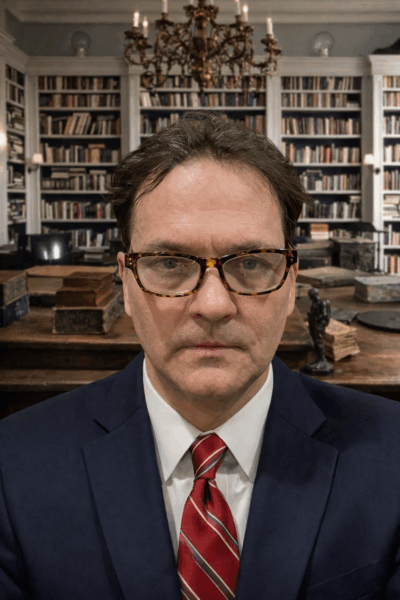
Craig C. Shelton is a philosopher, author, and institutional architect whose work is devoted to restoring coherence in an age of abstraction.
His career spans science, cuisine, organizational leadership, and philosophy—not as parallel pursuits, but as a single line of inquiry shaped by lived consequence. Across these domains, Shelton has pursued a consistent question: how systems shape perception, and how distorted perception quietly produces institutional failure.
Formation
Shelton’s intellectual formation began in the sciences. He studied molecular biophysics and biochemistry (MB&B) at Yale, where he learned the disciplines of empirical humility, precision, and fidelity to reality as it is rather than as one wishes it to be. That scientific grounding continues to inform his resistance to abstraction untethered from evidence and consequence.
He later entered the world of fine dining and hospitality, working in some of the most demanding kitchens in the world and earning national recognition as a chef and restaurateur. Kitchens, he came to see, are not merely places of production but living institutions—environments where attention, hierarchy, craft, and human nature are tested under real pressure. In such settings, abstractions fail quickly and incentives reveal themselves.
It was here that Shelton began to recognize a pattern that would later define his broader civilizational critique: systems fail not primarily because people are malicious or incompetent, but because institutions are designed in ways that distort perception, reward extraction, and sever action from consequence.
Work
Shelton’s published work unfolds as a single integrated project.
His early writing examined political economy and institutional design from first principles. That inquiry expanded into education, governance, culture, and consciousness, culminating in Integral Liberty, his unified philosophical system and civilizational blueprint.
Integral Liberty argues that freedom cannot be sustained on preference, procedure, or ideology alone. It must be grounded in reality itself—in the structure of the human person, the nature of attention, and the conditions required for self-government to remain possible.
Central to this work is the Integral Liberty Ethics Engine (ILEE), a formal evaluative framework Shelton developed to help leaders assess whether policies, technologies, and institutions remain aligned with human flourishing—or whether they quietly generate structural harm despite good intentions. ILEE is designed not to moralize, but to clarify.
Posture
Shelton is intentionally non-partisan. His work is restorative rather than revolutionary, skeptical of mass solutions, motivational rhetoric, and abstract reform.
He favors slow thinking, proportion, and fidelity to the real. His conviction is that institutions cannot be repaired by technique alone, and that no durable renewal is possible without the formation of persons capable of attention, judgment, and restraint.
Orientation
Shelton writes and works for those who sense that something fundamental has gone awry—and who are willing to look upstream of symptoms. His audience includes leaders, educators, artisans, and citizens who are less interested in persuasion than in clarity.
He lives and works in New Jersey, and remains actively engaged in writing, advisory work, and the continued development of the Integral Liberty project.